Treat it as a floor
The calculator estimates the minimum rate needed to support your income goal after expenses, taxes, unpaid work, and time off.
Freelance pricing tool
Convert target income, expenses, taxes, unpaid time, and realistic billable hours into a practical freelance rate.
Pricing guide
The calculator estimates the minimum rate needed to support your income goal after expenses, taxes, unpaid work, and time off.
For fixed-fee work, estimate hours conservatively and add margin for revisions, project management, and client communication.
Update the inputs when your expenses, tax situation, availability, or demand changes.
Launch offer
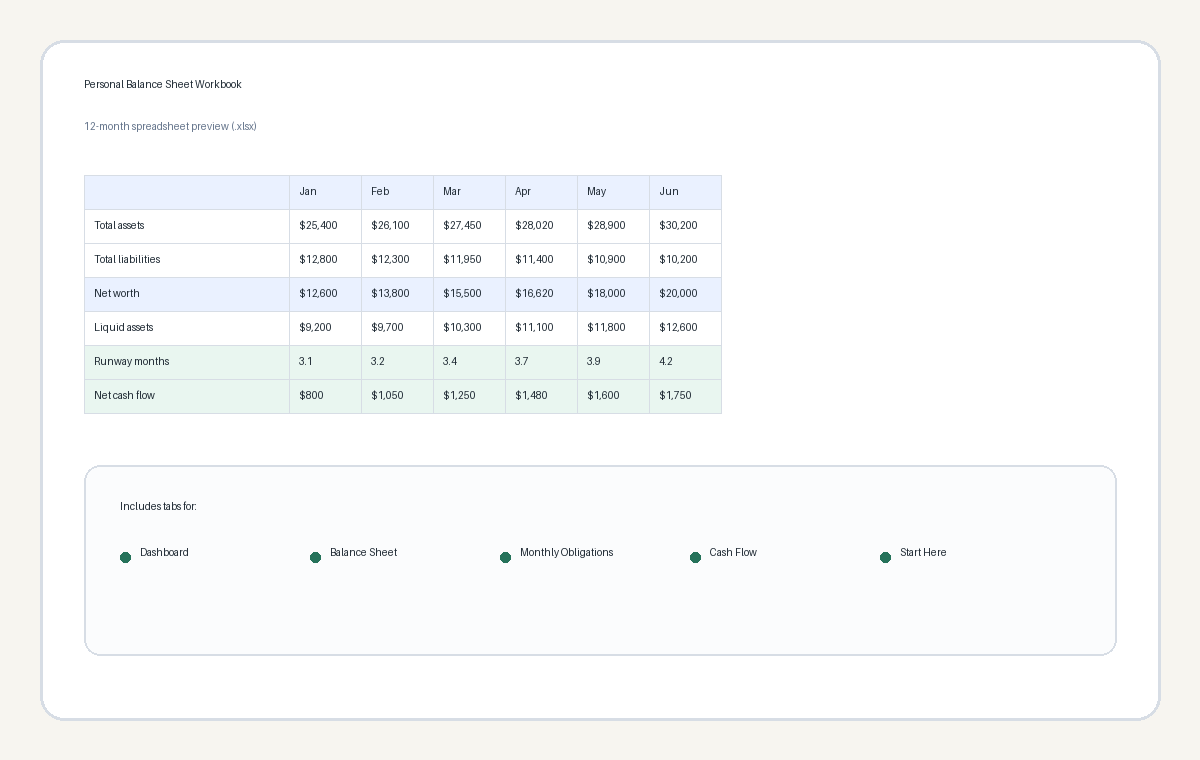
A printable workbook for seeing assets, debts, monthly obligations, and runway in one place before you set rates or take on bigger freelance decisions.
If it is not useful, request a full refund within 7 days.
What's inside
List cash, savings, investments, retirement accounts, business cash, and other assets with notes.
Capture debts, balances, minimum payments, interest rates, and the obligations creating pressure.
Turn the totals into net worth, liquid assets, must-pay monthly expenses, and runway.
Separate must-pay expenses from flexible spending before making rate, career, or freelance decisions.
Connect your financial baseline to the rate calculator, quote decisions, and near-term next actions.
Use a short sequence to gather balances, estimate obligations, review debts, and choose one cleanup action.
FAQ
No. This is a planning calculator. The tax input is only a rough estimate so you can see how taxes affect the rate you may need. Confirm tax assumptions, deductions, and local rules with a qualified professional.
Freelancers usually cannot bill every working week. Vacations, sick days, holidays, client gaps, admin work, sales calls, onboarding, and professional development all reduce the number of hours that can realistically be invoiced.
Often, yes. The result is a rate floor, not a ceiling. Your public rate may be higher if you have specialized expertise, strong demand, fast turnaround, unusual risk, or work that creates meaningful business value for the client.
Common examples include software subscriptions, equipment, payment processing fees, insurance, contractors, bookkeeping, coworking, education, professional services, marketing, and business travel. Use annual estimates so the calculator can spread those costs across your billable hours.
Employee salaries and freelance rates are not the same. A freelancer usually pays for non-billable time, tools, taxes, benefits, sales, admin, and gaps between projects. The calculator makes those hidden costs visible.
Estimate the total hours required, multiply by your calculated rate, then add a project buffer for revisions, communication, delays, and uncertainty. The worksheet is designed to make that project quote math easier.
Review it at least quarterly, or whenever expenses, availability, demand, or client quality changes. A small quarterly review is often easier than waiting years and making one large jump.
Freelance pricing is easier when you know your real financial baseline. A balance sheet helps separate income goals from current obligations, debts, cash, and runway, so the rate decision is less abstract.
During the temporary email checkout phase, request the workbook by email and delivery is handled manually. After Gumroad or Payhip is connected, checkout and PDF delivery will be automatic.
It is a US Letter PDF designed for printing or writing on with a tablet PDF annotation app.
If the workbook is not useful, request a full refund within 7 days by emailing jkirshenman@gmail.com.